http://www.earthlife.net/inverts/nemertea.html
http://www.ucmp.berkeley.edu/nemertini/nemertini.html
Rupert, Fox, Barnes. 2004, Invertebrate Zoology, Thomson
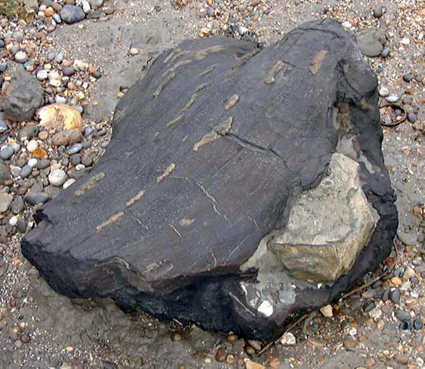
The fossil record is sparse, which is no surprise for soft-bodied animals, but surprisingly the hard stylets are not even found. A fossil (Archisymplectes) which may represent a Nemertean was found in Mazon Creek (Illinois), and is dated to the Pennsylvanian (325-299 MYA). The Nemerteans are believed to have been present over 500 MYA in the Cambrian or Pre-Cambrian even though fossil evidence doesn’t imply this.
(not actual picture of Nemertea fossil)
Nemerteans have a superficial resemblance to Annelids, they share a multiciliated glandular epidermis, protonephridia, spiral cleavage, and the ladder-like nervous system. But have clear differences which include a circular cross-section, a complete gut, a unique blood-vascular system with and endothelium, the proboscis, and the presence of a coelom (rhynchocoel).
The Nemertea also have superficial resemblance to the Nematodes. Only they have complex circular and longitudinal muscles and don’t molt.
The Nemertea have two separate sexes, although all the freshwater species are hermaphroditic. The fertilization is often external. Eggs get shed and dispersed in burrows, tubes, or gelatinous strings.
The body of the Nemertean is made of a layer of glandular epidermis (full of cilia), a layer of connective tissue, and a thick muscular layer. Lack exoskeleton and cuticle, but can secrete a toxic substance for protection. They are quite often colourful (showing there toxicity?) or in contrast dull and plain. The musculature is made up of a thin layer of circular muscle, surrounding a think inner layer of longitudinal muscles. Helical muscles connect the longitudinal and circular muscles and allow for twisting and coiling. Dorsoventral muscles are responsible for flattening the body.
Respiration is achieved through diffusion and circulation is made possible by a coelmic system with peripheral vessels carrying fluid throughout body. The Nemertean nervous system consists of a brain and several nerve cords. The brain is 4 anterior ganglia arranged in a circular ring. The nerve cords are filled with non-circulating neuroglobin, which extends time restraints on oxygen intake. The excretory system is made of two anterior fore-gut protonephridia which filter the fluid and send the wastes to collection ducts which lead to the anus for removal from body.
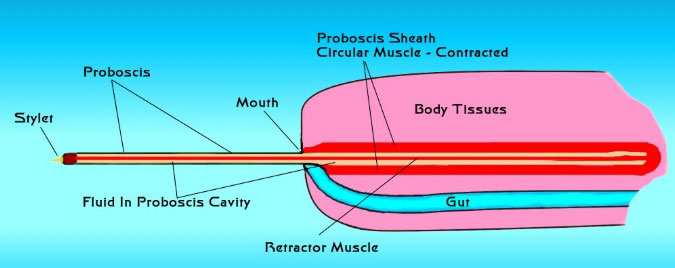
A key defining feature of the Nemertea is there proboscis which is housed in a true coelom called the rhynchocoel. The proboscis is everted in the coelom, where it shoots out and wraps around its prey and kills it, the proboscis is then retracted back into the rhynchocoel bringing the prey with it. Nemerteans are predators of crustaceans, annelids, Mollusca and other Nemerteans, and are capable of consuming prey many times wider then themselves.
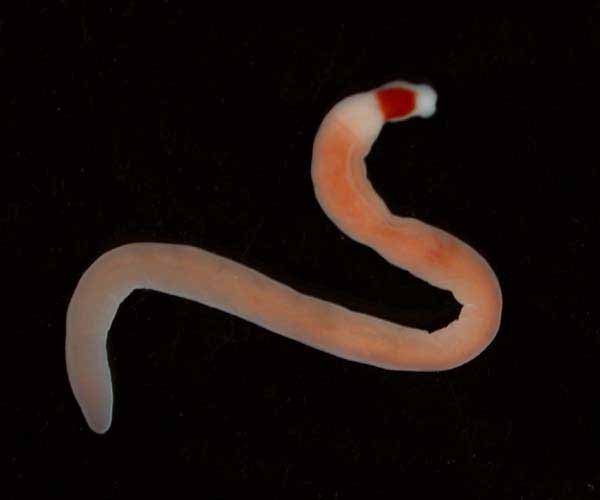
The phylum Nemertea is in the kingdom Animalia, and the super phylum Lophotrochozoa. It is home to approximately 1150 different species. These species differ in trophic association along with the environments they are found in. Species of Nemertea have been found to be scavengers, parasites, and herbivores. But the common Nemertean worm is 10-15 cm long, circular, found in a marine habitat and is a carnivorous predator. Fresh water (12 sp.), pelagic, deep water, and terrestrial (approx 15 species; found in tropical areas where it is damp and humid) also exist.