Monday, December 3, 2007

Other sources to veiw

http://en.wikipedia.org/wiki/Nemertea


http://www.earthlife.net/inverts/nemertea.html


http://www.ucmp.berkeley.edu/nemertini/nemertini.html


Rupert, Fox, Barnes. 2004, Invertebrate Zoology, Thomson


Another video link

http://video.aol.com/video-detail/nemerteans/3368359166


Kinda funny- Starts out seeming to be informative, to end up as mostly just a guy complaining about there existence.

Terrestrial species

http://www.oceanfootage.com/stockfootage/Worm_Invertebrate

4th and 6th video down

Link to a possible Large Nemertean. Referred to as a Sea Monster

http://www.livevideo.com/video/A1E97D4CDC3D4FF899F90B9FE41AB5E6/jay-s-nemertean-worm-.aspx

Annotated BIBLIOGRAPHY

Ph. Nemertea, Cl. Enopla, Or. Hoplonemertea, subOr. Monostilifera, Fam. Prosorhochmidae

Gerlach, J., 1998, The Behaviour and captive maintenance of the Terrestrial Nemertine, Journal of Zoology, 246, 233-237

The goal of the study was to learn more about the Geonemertes pelaensis. A generalized search will be done in there known habitat in tropical island area, Seychilles, where observations will be kept on locations found. Scientists will then try provide a sustainable habitat, and observe unknown features of there behaviour and diet.

Until this study no Geonemertes pelaensis samples where successfully preserved alive for any period of time. They require a moist humid environment, and won’t survive otherwise. It is extremely hard to view activity (behaviour) since they are nocturnal creatures and will hide at the presence of the slightest light.

Samples of Geonemertes were collected, and the percentage of different areas where a sample was observed was also kept (banana leaves, rotten logs). The samples were then put in a box with an abundance of prey. Four types of prey were tested, small gastropods, collembolan, mites, and isopods. G. pelaensis was found in 100% of the banana leaf sites, 33% of the palm leaf sites, and 50% of the dead tree sites. They consumed prey on an average of 0.6 a night, with 2 per night as a maximum.

  • The species G. pelaensis was most commonly found 60 cm above ground, perhaps due to predation from the terrestrial crab. It was most commonly found in dead trees, banana leafs and palm leafs, and not near dry or coastal areas. They prey on small gastropods, specifically liordetiasculpta, Allopeasgracile, and subulinaoctona
Annotated BIBLIOGRAPHY

Ph. Nemertea, Cl. Enopla, Or. Hoplonemertea, SubOr. Monostilifera, Fam. Carcinonemertidae

Roe, P., 2004, Ecological Implications of the Reproductive Biology of Symbiotic Nemerteans, Hydrobiologia, 156, 13-22

A closer look at several Nemertean species, and some reproductive modifications they have undertaken that suspiciously resemble that of a parasite. Is a species which lives around another species (host) and also exhibits reproductive advantages (comparable within groupings) a parasite? Are there more parasitic Nemerteans then once thought?

The species mentioned are sometimes considered egg-predators and not parasites. The example species exhibited reproduction modifications in the form of, increased egg production, parthenogenesis, hermaphroditism, and reaching sexual maturity earlier.

Study described several species which are potential parasites of different crustaceans and mollusks. Found reproduction to be correlated with hosts egg availability. Found that the number of gonads in most studied species were much higher then that of free-living species. The proboscis was reduced (no need for it), and they all exhibited reproductive advantages. C.carcinophila imminuta lay approx. 1200 eggs, C. epialti lays approx. 1900-3500 eggs, and the free-living comparison Protoma lays 210 eggs.
Findings suggest Nemerteans associated with hosts and have reproductive modifications typical of parasites should be considered parasites themselves. This way predictions of the species lifestyles can made based on reproductive and habitat observations. Following this methodology will produce more potential parasitic species for further study

Fossils...or not


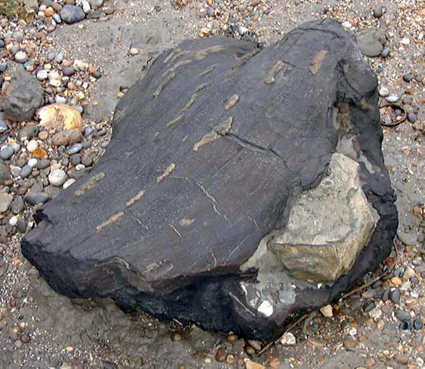
The fossil record is sparse, which is no surprise for soft-bodied animals, but surprisingly the hard stylets are not even found. A fossil (Archisymplectes) which may represent a Nemertean was found in Mazon Creek (Illinois), and is dated to the Pennsylvanian (325-299 MYA). The Nemerteans are believed to have been present over 500 MYA in the Cambrian or Pre-Cambrian even though fossil evidence doesn’t imply this.

(not actual picture of Nemertea fossil)